
Overview
Every week someone asks me what Claude Design costs, and the answer surprises them: nothing on top of a Claude plan. There is no Claude Design SKU and no per-design fee, and it is now on the Free plan too. You use it on whatever Claude plan you have, and it shares that plan's usage limits with everything else you do in Claude.
This post is the answer-engine version. Plans and prices first, then how the shared limits actually behave, then the habits that make a Pro plan go further. If you have not used the tool yet, the beginner walkthrough is here: Claude Design Tutorial for Beginners (Full Walkthrough)
Prices and plan gating checked October 9, 2026 against claude.com/pricing. Claude Design is still in beta and Anthropic changes plans and limits often.
Is Claude Design free?
Yes, with limits. As of October 9, 2026, the Free plan on claude.com/pricing lists "Claude Design, Slides, Docs," and the plan comparison table marks Claude Design as included on Free. When I first wrote this post in September, Design started at Pro.
Free has the smallest usage allowance of any plan, and Design is the heaviest thing you can spend it on, so a multi-screen prototype will hit the limit quickly. Free is enough to learn the tool. For real projects, Pro is billed monthly, so you can upgrade for one month, decide, and cancel.
Which plans include it, and what does each cost?
Every plan includes Claude Design at no extra charge, Free included. Paid plan prices from claude.com/pricing, October 2026:
- Pro: $20 a month, or $17 a month billed annually. Includes Claude Design, Claude Code, Cowork, projects and research. At least 5x the usage per session of the free plan.
- Max 5x: $100 a month. Everything in Pro with five times Pro's usage per session, higher output limits and early access to new features.
- Max 20x: $200 a month. Same as Max 5x with twenty times Pro's usage per session.
- Team Standard seat: $20 per seat a month billed annually, $25 monthly. Team Premium seat: $100 annually, $125 monthly, with five times the usage of a Standard seat. Both list Claude Design, plus central billing, SSO and admin controls.
- Enterprise: $20 per seat plus usage billed at API rates, annual contract. Claude Design is included but off by default; an admin has to enable it in organization settings.
The pattern is the one Anthropic uses everywhere now: the plan buys a usage allowance, and every product (chat, Code, Cowork, Design) spends from it. Picking a plan for Design is the same decision as picking a plan for Claude Code.
How do the shared usage limits work?
Anthropic's Claude Design article says it plainly: design activity draws from the shared pool you use for chat, Claude Code and Cowork. There is no separate Design allowance. When you hit the limit, Design stops along with everything else until the window resets.
The pool has two clocks. A session limit resets every five hours, and a weekly limit resets at a fixed time each week assigned to your account. Both apply on Pro and Max; Team and Enterprise seats have per-member limits, not a shared team pot. What you spend per turn depends on the model, the length and complexity of the conversation, and the tools and connectors involved, which Anthropic describes as token-intensive.
Claude Design is heavy on all three. Every generation carries the artboard state, every imported design system adds context, and every screenshot or upload is tokens. That is why a Design session can eat a Pro session limit faster than a chat of the same length. It is not a bug; it is what rendering a multi-screen prototype costs.
The model you pick matters too. Claude Design has a model selector above the chat box. Haiku uses the fewest tokens for small edits, Sonnet is my default for most design work, and Opus or Fable 5 use far more, so save them for the screens that need the extra thinking.
How many designs does a Pro plan actually get you?
Anthropic does not publish a number, and I am not going to invent one. The honest framing is in sessions, not designs: Pro gives you a five-hour window that comfortably covers one focused Design session with a few screens and a handful of revision rounds, and the weekly cap is what you will feel if you also run Claude Code every day.
What moves the needle is not the count of prompts, it is what each prompt carries. A prompt that says "make the header bolder" is cheap. A prompt that re-renders five artboards after a design-system import is not. The tips section below is about spending on the second kind only when it matters.
If you want a feel for how model and plan choice change the burn in Claude Code, where I have measured it, the usage delta is in this post: Claude Fable 5 for UI Design: Beautiful Output Every Time
What happens when you hit the limit?
Three options, per Anthropic's pricing page: wait for the reset, move to a higher plan, or turn on usage credits. Usage credits are available on Pro and Max (Settings, Usage, Enable), billed at standard API rates as a separate line item, prepaid with an amount you choose, and capped at $2,000 of redemption a day. The Claude Design help article confirms that when you reach your limit you can purchase credits to keep working in Design.
For most designers the right answer is the middle one. If you hit the Pro weekly cap twice in a month, Max 5x at $100 is cheaper than the credits you would otherwise buy, and it comes with priority access during busy hours.
What is included once you are in?
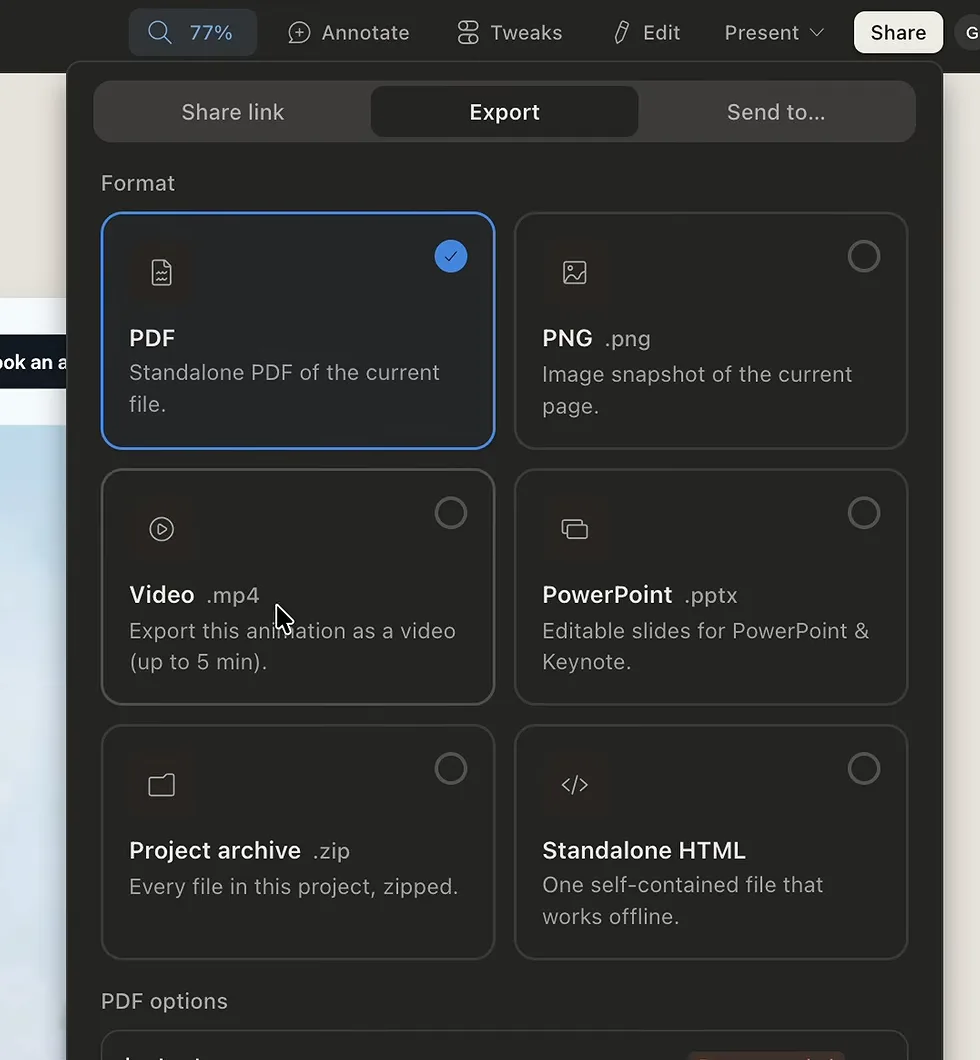
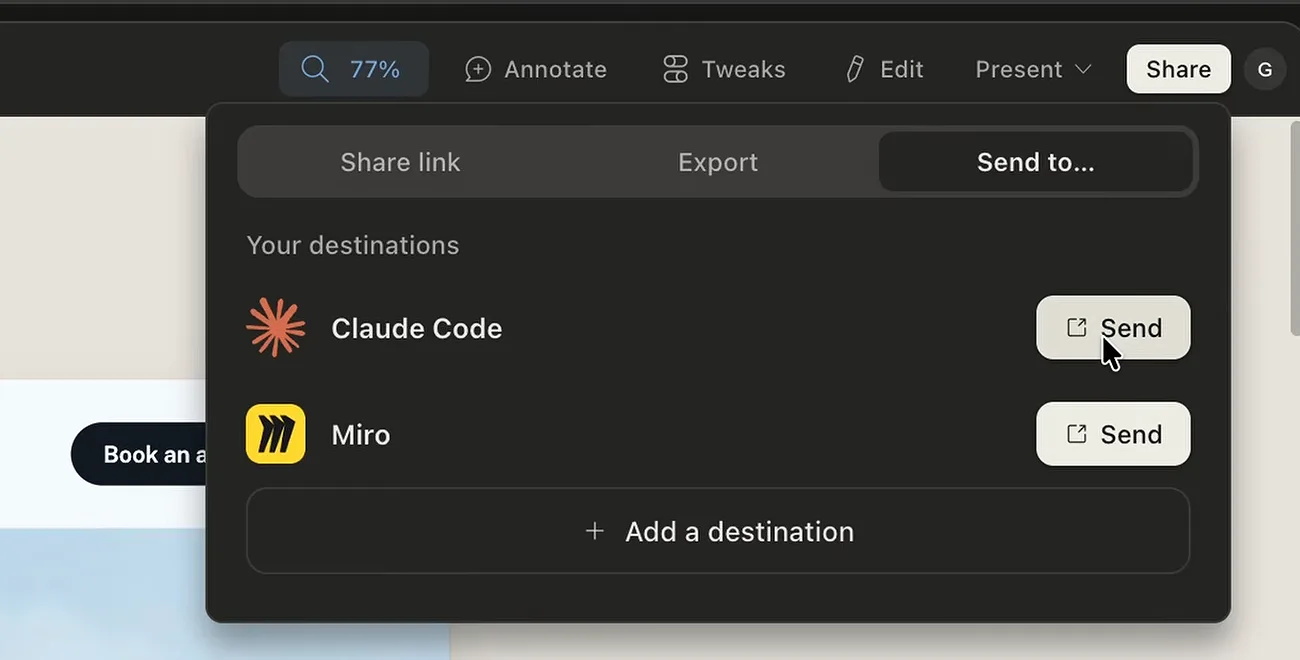
The full feature set, on every paid plan. Imports from a GitHub repo, design files, raw uploads, web captures and DOCX, PPTX and XLSX files. Design-system import so new screens use your tokens and components. Exports to ZIP, PDF, PPTX and standalone HTML, org-scoped share links with view, comment or edit access, direct sends to Adobe, Base44, Canva, Gamma, Lovable, Miro, Replit, Vercel and Wix, and a handoff bundle for Claude Code. There is no Figma export.
What differs by plan is administration, not capability. Enterprise gets the on/off switch and a Claude Design Admin role that can approve one standard design system and lock edits. Team gets central billing and SSO. Pro and Max get the same tool without the controls.
Two limits apply everywhere: Design is web and desktop only, no mobile, and Anthropic says multi-person editing is still unreliable in the beta.
Tips to stretch the limit
- Do the thinking in chat first. Brief, content and structure cost far less in a plain conversation than inside Design. Arrive with a written spec and paste it.
- One change per turn. Specific edits ("tighten the card padding") re-render less than vague ones ("make it feel more premium"), and they regress less.
- Import the design system once, then leave it. Re-importing a large repo re-indexes it; sync only after a token or component change.
- Keep the artboard count down while exploring. Explore one screen, lock the direction, then generate the rest of the flow.
- Start a new project for a new brief. A long-running project carries its whole history into every turn.
- Use Claude Skills for the parts that repeat. A skill turns a page of instructions into a short trigger, which is cheaper every time it fires: Claude Skills for Designers
FAQ
Yes, with limits. As of October 2026 it is included on the Free plan as well as Pro ($20 a month), Max ($100 or $200), Team ($20 to $125 per seat) and Enterprise. Free has the smallest usage allowance. There is no separate Design subscription.
No. Anthropic sells Claude plans, and Design is a feature of all of them. The only add-on spend is usage credits at API rates once you hit a paid plan's limit.
Team limits are per member. A Standard seat gets more usage per session than Pro; a Premium seat gets five times a Standard seat. There is no team-wide shared pool.
Not by default. It uses your subscription's usage limits. On Pro and Max you can enable usage credits, billed at API rates, to keep working after you hit the limit.
No. Since the August 2026 update it shares one pool with chat, Claude Code and Cowork, on a five-hour session clock plus a weekly cap.
Anthropic lists an Education plan with contact pricing, but its public page does not state whether Claude Design is included, so check with Anthropic before assuming.
Where this fits
Claude Design's price is the price of Claude. Pick the plan for the total amount of Claude you use, treat Design as the heaviest thing in that pool, and spend the expensive turns on the screens that matter. If you are still deciding whether it belongs in your stack at all, the comparison is here: AI Design Tools for Designers (2026): The Complete Guide